A Turning Point for Canadian Energy

I read a thoughtful analysis that talked about Chrystia Freelands task to convince her colleagues in government that we can achieve our climate targets while having a vibrant energy industry.

She appears to be a lone figure in government.  Many of her Liberal colleague MPs, Cabinet Ministers, and even the Prime Minister see the oil and gas industry as the villain responsible for the entire problem.

Ms Freeland is correct – and needs to be listened to.

Canada could shutter our entire energy industry, and it would make little if any difference to global emissions.  In fact, it might result in an increase, hard as that may be to believe.

Canadian oil and gas is produced with efficiency that is good and is improving quickly.  Canada is a world leader in this technology, and the spending by industry is large.  The TOTAL emissions from extraction and refining in 2017 was 124 Mt out of a total of 716 Mt for Canada.  Road transportation, by comparison, was responsible for 144 Mt.  If the Oil and Gas industry was eliminated, we would simply import our needed energy as Quebec and Atlantic Canada already do.  The emissions from production by corrupt governments and the long-distance transport would almost certainly result in higher emissions than our industry produces.

Public Electricity and residential heat generation produce almost the same emissions as the oil and gas industry produces, but ironically, the electric industry delivers only about 20% of our total energy, and the electricity industry in Canada is more than 75% based on emission free generation.  A small portion of our electrical generation, largely based on coal power, produces a disproportionate share of our emissions.  One never hears much about this, but to be fair, significant programs are under way to sequester the emissions from these sources.  Our energy industries are far more proactive than they are given credit for.

Overall, industry in Canada, which is responsible for less than half of the total emissions, has made real progress in reducing their impact, and some, including Teck and Fortis have made strong commitments, that are funded by their boards, to reduce emissions.  Teck, the applicant for the Frontier Oil Sands Project, had previously made a commitment to net zero emissions by 2050.  FortisBC, that owns both electricity and natural gas utilities and sells more energy in BC than BC Hydro, has a 30BY30 program that targets emissions by customers using their energy by 30% by 2030.

Contrast that to public use.  Sales of SUV and light trucks that produce more than twice the emissions of a hybrid car, have increased their sales by more than 50% in the last 6 years, while the sales of cars have fallen by about 1/3.

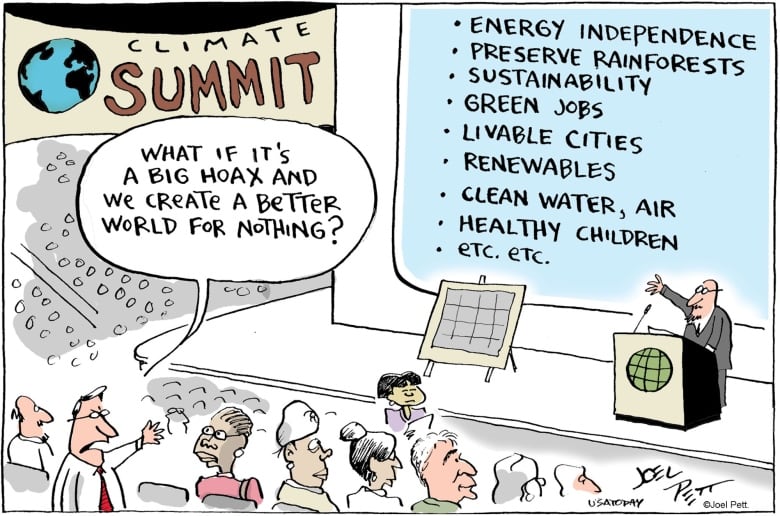
Climate change is a serious issue that must be addressed, and Canada is truly a laggard.  Our emissions based on 2018 numbers have declined about 1% in the last 4 years, while the US, where the president thinks this is a hoax, is down 5% and the UK is down by about 20% and has a real plan to reach net zero emissions by 2050.

The problem is not so much the sources of the energy – the world has ample capacity, driving prices lower.  The problem is in the use.  We ALL need to reduce our consumption.  Canadians are among the highest energy users on the planet.  We love to blame China and India, but the numbers tell a different story.  Canadian annual emissions are 15.1 tonnes/capita, while China and India emit 7.5 and 1.7 tonnes/capita annually.

I am old enough to remember a quote by “Pogo” in an old cartoon that used to be in our newspaper… “We have seen the enemy – and it is us!”

Canada Climate Emergency

Canada’s House of Commons  recently declared a “Climate Emergency”. This is not surprising. When one looks at progress made by government action since 2014, Canada has reduced total emissions of 723 MT by less than 1% (2017), and we have committed to reduce emissions by 30% by 2030. We had previously established a target to reduce to 17% below 2001 levels by 2020. That would make the 2020 target a little over 600 MT, a target that is now well beyond reach.

When one looks at the actions taken by government, regulation and legislation appear to have failed badly. Consider the following:

  1. A carbon tax is being introduced. The concept of a carbon tax won a Nobel Prize, but studies have shown that the tax must be >$200/T to be successful. Even the Parliamentary Budget Office suggested that a tax that was less than $100/T would be ineffective. Our government has committed to limit their carbon tax to be less than $50/T and they partially exempted some of the largest emitters that burn coal. This is hardly a path to success – in the short time that is available.
  2. The government recently gave a grant of more than $10M to a grocery chain to allow them to replace freezer systems in their stores, aimed at reducing emissions. Most of the stores included are located in provinces where electricity is either carbon free  or near carbon free. Most of this expenditure will have no impact at all on emissions.
  3. Governments seem to believe that the only solution is to abandon all fossil fuels and convert immediately to renewables. Renewables may provide the low-cost electricity, but the intermittent nature also requires costly storage and controls that in many cases makes them uneconomic. This belief has led to significant “unintended consequences.” The Ontario government decided to implement many new wind generation facilities, and now experiences surplus capacity at night. Disallowed by government to sell at market prices below zero, the utilities have at times resorted to eliminate the surplus by reducing nuclear capacity and dumping steam from the reactors into Lake Huron. It is ironic that Ontario has an outstanding team of people that have planned and operated their grid for more than 100 years. For much of the time Ontario enjoyed the lowest cost electricity on the continent. Recent poorly informed government decisions have resulted in Ontario electricity costs now being among the highest on the continent.
  4. I watched the Canadian premiers on TV at their annual meeting in Saskatoon. They talked about an energy corridor across Canada, which may be a good idea, but it may also have problems. Ontario is not permitted to sell at negative prices and would expect a fair price for any surplus sold to Quebec or Manitoba where there are ample hydro facilities to store their surplus energy. BUT why would Quebec, BC or Manitoba pay for surplus energy from a neighbour when US utilities will pay them to take the energy (selling at negative prices),  as happens today?

There seems to be an almost unlimited number of examples that show that government regulation has had little or no impact on emissions and often has often led to unintended negative consequences.

I am reminded of a situation from about 1900. At the time, there were more than 100,000 horses on the streets in New York, and more than 80,000 in London. The streets were strewn with horse manure; a significant health hazard. Government officials met in 1900, setting a target to reduce the number of horses by 10% before 1910.

By 1906, very little progress was reported, largely because the governments had no real plan of what could be done. In 1908, Henry Ford introduced his Model T and by 1912, almost all the horses were gone. Innovation and a disruptive technology had changed the problem to a profitable opportunity. That technology soon spread across all international boundaries.

Many years later, in 1985, Motorola sold a cell phone that was known as the “Brick.” Seeing this new technology, AT&T hired a consultant to determine the market potential for annual sales in 2000, some 15 years later. The study showed a target of 1 million phone sales, and AT&T decided to “pass” on the opportunity. But in 1996, the Li-Ion battery became available and smart phones quickly flooded the markets. By 2000, sales were over 100M units annually.

In both cases, the technology spread rapidly, with little government support or regulation, and in the case of cellular phones, they were soon available, even in the poorest countries on earth.

Climate change and carbon emissions are a global problem, and the sources are very different. The three largest polluters in the earth are China, the US, and India. Canada ranks 9th in total emissions. But the per capita use is revealing. China emits almost double the US total, but the per capita emissions are about 40% of per capita emissions in either Canada or the US. India, the third largest emitter has per capita use that is about 1/10 of the Canadian or US. It is apparent that a solution that may work in Canada and the US, may be completely unfeasible in India and other countries where population is large and individual use is small. A technological solution must be found that can be widely used and will not destroy the economy for any country. Ontario had a problem a few years ago with rural electricity rates that were very costly. Some people were faced with a choice of buying food or energy.

The current plan to eliminate fossil fuel will create very significant disruption, and potentially very high costs. Solar energy collection in Canada is heavily weighted to the April – October months, while total energy demand is weighted through the winter, almost the exact opposite of the solar energy. A battery to provide all energy needs for a solar powered home in Canada would require storage of 6-7 MWh, at a projected cost ($100/kWh) of almost $1M, including inverters and chargers. A utility that is required to use solar and has no access to hydro would have an equally impossible cost for storage. Clearly, that will not happen.

Recently we have seen new technologies appear that may have on global targets. One, announced in Calgary, was a process that reacted C02 with natural Gas (CH4). The demonstration showed that the process could be used to create carbon fibre, a strong, light material that is extensively used in new aircraft, and could become a powerful building component. Another process removed CO2 from the air and created hydrocarbons using a reaction with Hydrogen. Both concepts have very strong potential to play a large role in the future. I expect that there will be many other concepts that have real potential.

Canada and the US are countries that have a high standard of education, and many of our young people have a keen interest, strong skills, an entrepreneurial spirit, and a lot of time. The missing pieces seem to be technical support and funding. A recent study showed that a large portion of the new cleantech companies in Canada had fewer than 30 employees and the average age was under 30. With a little help, these people could become the powerhouse of a clean future.

Universities have the skillsets, and most want to support industrial research. The fit with these start-up companies should be easily accomplished.  With a little help from governments, industry or other individuals to support these young entrepreneurs, it is likely that many problems could be solved.

One thing is clear. Continuing on the current path is almost certain to fail. Our electric grid currently delivers about 20% of total energy, and any dramatic reduction in fossil fuel use will almost certainly impact the existing grid significantly. We need to either find ways to deliver more energy, or dramatically increase the size and capacity of our electric grid.

Approvals for major projects now take up to 20 years to accomplish. That is far too long, given the urgency of the situation. We must harness all the skills that we have, engage and encourage the young, ambitious entrepreneurs, and focus on a single mission to do this job. The time for action is NOW.

IMG_0217

Climate Change – and Energy – A Canadian Perspective

I have heard some very bold statements recently.  We suddenly seem to have a lot of climate experts with all sorts of strong advice.

  • The mayor of Whistler found himself in trouble recently, when he wrote to an energy company, essentially laying much blame for our climate issues at the feet of the Canadian Oil companies. I now note that a collection of mayors is trying to put together a class action lawsuit against these same companies.
  • In the last few days, a paper published in LinkedIn suggested that we would soon see a lot of people going “off grid.”

These comments come from people that have best intentions, and in fact, this shows that there is a rapidly growing commitment to address the energy/emission situation.  I share some of the views and congratulate people with some authority that want to act, and not just talk.  But we need care.

Perhaps it is also a good time to have a look at some of the common assumptions for needed change and dig into what they might achieve.  Then take a separate look at what the sources of problems are – and compare the two, to see if we are getting value.

There is an interesting source of data on the Government of Canada website that gives a summary of energy sources and uses in Canada.  Fig 1

First, what are our major sources of emissions in Canada. Figure 1 shows that industry is our largest source of emissions, but close behind is our transportation system.  Between the two areas, they are responsible for more than 2/3 of total emissions.

Oil and Gas Industries

There is no doubt that our oil and gas industries are significant contributors to this total, but perhaps it is useful to look at the progress that has been made in recent years. Fig 2Figure 2 shows a significant improvement in the oil sands production efficiency, and in fact, oil sands products now are cleaner than some of the foreign products that we seem happy to import. Fig 3Figure 3 shows a comparison of the emissions created in the preparation and delivery of petroleum from a number of sources, and it is pretty clear that oil sands oil is not as bad as many wanted to believe.

The second source of significant emissions is transportation and almost 60% of total emissions here are from the use of personal vehicles. Fig 4Figure 4 shows the use of transportation fuels and the related emissions.  It is interesting to note that passenger car emissions have fallen only slightly, while passenger light trucks have grown by more than the car emissions have decreased – the total has been increasing slowly but steadily.

Overall, it appears that industry has been investing in methods of reducing emissions and improving their overall efficiency, but the private vehicle owners have made little if any progress. Perhaps this is a significant driver for the implementation of a carbon tax.

 Electricity

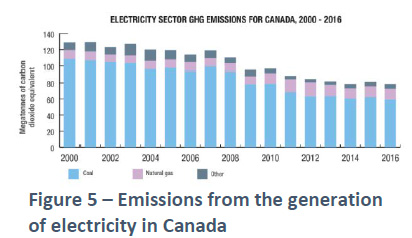
The NRCAN website shows that 81% of the energy sources used to generate electricity are carbon free.  Our electric supply is relatively clean, and in fact is far better than the US, that still generates more than half of their electricity with fossil fuel.  In some provinces, the electricity is almost all emission free (BC, Manitoba, Quebec and Newfoundland and Labrador), while in Alberta and Saskatchewan, aggressive programs are in place to reduce emissions, either by displacing coal with gas, or using carbon capture technology.  (Fig. 5) Fig 5


Summary

It appears that there is significant progress being made to reduce emissions by industry sectors while the demand side seems to have achieved little and is happy to assign blame to others.

What am I seeing?

I am seeing a large amount of interest in building new homes that are “net zero” energy.  This may be a very good initiative. I also hear about people wanting to go “off grid.” There are some important issues in personal energy use as follows:

  1. Electricity provides less than about ¼ of total energy, and in more than half of the country, the electricity is already carbon free. Why are we pushing solar – simply to displace existing hydro or other clean source of energy?  Would we not be better off to try to spend the same amount to reduce real emissions?
  2. The concept of using solar to go off grid is another interesting objective. I did a study on my own home in the Okanagan valley.  Displacing the supply of electricity that I use, not including the heat for the house and fuel for the car might be quite easy.  But it would accomplish relatively little.  In my home, more than 75% of my annual consumption (We have one car only, and it is electric.) occurs between mid November and early March.  At the same time, the more than 70% of our incident solar energy here comes between April and September.  I would need a good battery to carry me through the winter.  In fact, to be self sufficient, I would need a 5 MWh battery, which at 2025 estimated prices (less than half of today’s prices) would cost US$500,000.
  3. As I drive through our town, I pass by the Automobile Dealers – and their lots are filled with trucks; big trucks. While I have no issue with the use of trucks where they are needed, why do they seem to have become the vehicle of choice for many people that have no need for a truck?

I attended a solar energy conference a while ago and I drove my Plug in Hybrid that I had at the time, thinking that I would charge the battery in one of several spots at the college that were equipped with chargers, and were reserved for electric cars.  To my amazement, all of the spots were taken by – you guessed it – big trucks.

I went inside and listened to people that condemned the oil companies, electric utilities, the government and praised conservation, solar and wind energy.

The hypocrisy does not stop with individuals that drive big trucks!  Governments are also just as bad, or perhaps worse.

The BC Government, with best intentions, required the utilities to implement a 2-tier electricity rate. The first block of energy (about 6-700 kWh/month) were delivered at a low cost, and after that, the price almost doubled.  This was supposed to encourage conservation.  But what it also did, was to make the use of heat pumps, the cleanest and most efficient form of heating, unfeasible.  The city of Vancouver later announced that there would soon be no fossil fuel used in the city, including for heat. Heat pumps would become the primary heating system.

Some US states pushed solar energy, and the result has been impressive.  Many people installed rooftop solar, expecting to sell their surplus to the grid operator.  That has delivered a consequence that was probably not expected but should have been expected.  The solar generation peaks in the afternoon, when power demand is relatively low, and in some cases, the local utility has paid homeowners for their surplus energy, only to have to pay another utility to take the energy because they cannot use it at the time.  But after sunset, they are out looking to buy the same energy back that they paid to have taken away a few hours earlier.  Sounds crazy, but this happens frequently.  The bad news for the utility is the fact that their overall energy sales are declining, but the peak demand after dark is continuing to increase, and that results in a need to expand. But with declining revenues, increased rates are required. Essentially, the solar owners are being subsidized by people that do not have solar.

What Needs to be Done?

I have spent too much time complaining about what is happening – so what needs to be done?  There are all of the usual suspects that you hear from everyone, but I would suggest…

  1. Stop blaming everyone else; India, China, Government, Oil companies etc.
  2. Find a way to work together. At present it seems that many solar owners hate the utilities and vice versa – find a way to work together.  The concept of going off grid is not likely to work in any area that has winter.  The users and utilities need to be partners, and there are many opportunities coming.  In Australia, one utility has supported home solar systems – with battery storage, and they owners allow the utility to manage their storage.  Everyone wins.
  3. Look for the big sources of emissions and focus on them. In Canada, the use of petroleum liquids is likely the biggest source that most of us use.  Natural gas happens to be a fuel that has half the emissions of coal, and while coal fired generation runs at about 30% efficient, gas can be used at up to 80-90%.  Find some quick means to stop burning coal, and replace it if necessary, with a high efficiency natural gas substitute.
  4. Be prepared to pay for pollution. The carbon tax in BC was initially unpopular, but the complaints seem to have disappeared and BC has good growth in jobs.  The tax revenue needs to be spent directly on other methods of reducing emissions, as was the original intent.
  5. And finally, for those mayors thinking of a suit against the oil companies, consider the fact that owners are responsible for their own pollution – you may well find yourself explaining to a judge why you have had unreported small spills in the past – and what steps were taken to avoid them. The oil companies are meeting a demand – and they are pretty careful about compliance – look at what happens when gas stations are closed. I believe that under Canadian Law, the owner of the fuel is responsible for impacts – not the supplier.

I am a firm believer that if we can get rid of the silo mentality that seems to exist, and stop seeing other groups as “the enemy,” that there is a lot of common ground that can be used to build a far better and cleaner future.

Intermittent Energy – A New Paradigm

We live in a time where change is needed – quickly.  Many politicians and renewable advocates seem to think that a wholesale change from fossil fuel to renewables is essential, and many would like the nuclear capacity removed at the same time.  The most recent reports suggest that this change needs to be well underway, and the emissions in significant decline within 11 years.

The numbers present a challenging picture.  In 2017 in the US, fossil fuel provided almost 80% of the total primary energy, while solar and wind contributed approximately 3% of the energy.  In Canada, in 2016, solar and wind provided only 0.5% of primary energy, while fossil fuel provided over 70% of primary energy.

Nonetheless, the targets are set, and many people and governments are seeking to displace ALL fossil fuel with renewable energy.  The results, to put it mildly, are bordering on dismal.  Canada has set targets that are ambitious, and seems to do relatively little, other than to talk about meeting the challenges.  We are far behind in our targets for reduced emissions.

I see people spending large quantities of money on rooftop solar, assuming that they will reduce their costs and save the planet.  At the same time, I see utilities in trouble, both operationally and potentially financially, while doing their best under current methods to accommodate, and in fact, to encourage this concept.

As James Avery, a senior executive at San Diego Gas and Electric said, “Customers are often trying to do the right thing for the environment by going solar, but they aren’t being incentivized to do the right thing for the grid or for their neighbors. Today, one set of customers is subsidizing another to the tune of more than $100 million per year.”

But at the system level, I also see real problems.  Intermittent sources are just that, and in some cases, the power available is difficult to predict.  The utility is expected to provide a reliable and firm source of power at all times.  People suggest that batteries will do that task, but it will likely take more than that.

From a 40,000-foot look, the utility is designed to work well, but there are a number of standards that have become the established norm for over 100 years:

  • The sources of power are dispatchable – they can be started and stopped according to a plan, and the output can be reliably managed. The utility expects to be able to fully control the power from almost any generator that is connected to their grid.
  • The load, on the other hand, may be intermittent, random and may be applied or removed at any time, without advance notice or warnings.

The system has worked well with this concept, and utilities have been able to manage economically while providing a reliable service.

The introduction of intermittent renewables has caused a little confusion.  These sources are generators, but in fact they act in the way that a load is assumed to do.  They are relatively random, and intermittent, and yet people want to run them as a generator that is “supposed” to be fully dispatchable.  That does not work within the current method of operation, and the results are visible.

But, in fact, the current system has other issues, and a good look from far above may produce a system that can accommodate a high level of intermittent sources and cure some other issues at the same time.

The existing system is not all that efficient in its methods of operation.  Utilities have developed very sophisticated systems to get the best out of their system, but there are some inherent issues:

  • Under the existing concept, when generators are run up and down during the day, as they must do to match a demand that has a wide range over a day, the generators are operating at less than maximum efficiency for much of the day. This may be either a large or a small loss, depending on the generator.  Some utilities have used market sales to other utilities to smooth out their operation and gain efficiency.
  • The transmission and distribution systems have a similar problem, in that the loss increases with the square of the current, so if you double the current to meet peak demand, the loss goes up by 4x.  It is more efficient to operate at a constant level.
  • The grid is designed to meet peak demand – an event that lasts about 15 minutes once annually, and perhaps not at all. The average demand on the grid is about half of the peak capacity that is available, and the system design is largely based on meeting peak demand. The addition of solar generation has reduced the mid day energy sales in many utilities, but the peak that occurs after dark, is continuing to grow, requiring added expense while the utility revenue may be falling as energy sales decline.  This is leading to some rate changes that may impact the financial viability of home based solar systems.
  • The addition of large amounts of solar generation result in very rapid changes in demand seen by the utility as the sun rises and sets, and this results in a need to use generators that can ramp up or down very quickly to match the change. Generally, this is not the lowest cost generation. So the utility is essentially experiencing higher costs as a result of the rapid changes in demand caused by increased penetration of solar systems.

There has got to be a better way – to run the grid, in a way that will get maximum efficiency on a continuous basis, deliver more energy, smooth the variations in the demands on central generation, and on the delivery systems, meet the needs of all customers, AND accept a large and growing component of intermittent generation.

The key seems to be that a major part of managing the grid will have to move from the “top” (Central generation) to the “bottom” – at the grid edge near the loads.  If the demand on the central generation and delivery system can be managed to be near a constant, the system could deliver almost double the energy that is delivered today and could operate at a  much better level of efficiency.

There are many people that have suggested to me that the central utility will soon be redundant.  I would strongly disagree with this concept.  The electrical grid currently delivers about 20% of the total energy.  I hear many people that think that if they can displace all of their utility supplied electricity, that all problems will be solved, but they seem to neglect the other 80%.  We need to include heating for buildings, fuel for our vehicles, and potentially a lot of other energy that will replace processes that currently rely on fossil fuels.  I would need enough energy to collect more than double my current electricity consumption to fully address my energy use, and that does not consider the fuels used to provide the services and supplies that I need.

What is needed is a long-term transition plan and short-term targets to capture the “low hanging” opportunities.  For example, the largest source of emissions in the US is the generation of electricity from coal.  This is a little frustrating as that one large source provides less than half of the primary energy to generate electricity.  And that electricity delivers only about 1/5 of the total energy used.  In other words, the biggest source of emissions is delivering only about 10% of the energy needs.   It seems obvious that getting rid of coal generation would be a very big first step in cleaning our air.  The longer term can then focus carefully on what can be done at the grid edge to accommodate more intermittent energy, smooth the demand and yet maintain stability and reliability.

There are real challenges ahead, but the ideas currently promoted by many politicians – get rid of all fossil fuel NOW and replace it ALL with intermittent sources is not going to work.  We need a plan that will meet the energy needs going forward, and a transition that will reduce the major sources of emissions quickly.

Energy Puzzle – The Missing Piece

I just saw Dr David Suzuki on TV claiming that we should build no pipelines – and get off fossil fuel.  I remember him well, when I was a student.  He was a well-respected expert professor in genetics at the University of BC in Vancouver and he was best known for his work with “fruit flies.”  As an engineering student, we all used to crowd into his final lecture each term and listen to him talking on a subject that he really knew well – the risks of “genetics engineering,” and the problems that it could lead to.  It was always spell binding.

Over the years Suzuki now seems to be viewed as an expert on energy, and yet, the papers claim he owns large houses, and drives an SUV.

We have real problems with climate, fossil fuels, and carbon emissions, but one needs to look carefully at what we face:

  1. The biggest sources of emissions in the US are the generation of electricity from coal, and the transportation industry (60% of which is for personal transportation). These two sources are responsible for more than 2/3 of the total emissions.  Canada is only slightly better, in that our electric system generates almost 60% of total energy with hydro and nuclear is a large contributor to clean electricity as well.  Our petroleum industry ranks second, behind transportation.
  2. Electricity provides less than 20% of total energy, the remainder is almost all fossil fuel. The average person gets fuel in three forms; electricity, natural gas, and transportation fuel (gasoline or diesel fuel).  Any major reduction in the direct delivery of fossil fuel will be expected to be replaced with electricity – and that may be a big challenge, given the fact that the electric grid at present delivers only about 20% of the total energy.
  3. Many people seem to think that if they can convert their current electricity use to solar energy, that the problem will be solved, but they tend to forget about heating and transportation fuel. In most cases, the fossil fuel energy is far larger than the electrical energy delivered.
  4. I keep hearing that the problem is someone else’s fault – Blame India, China, the oil industry or the government. We all need to look in the mirror – and see the big users.  North Americans are among the largest users of energy per capita in the world.  As “Pogo” would have said ”We have seen the enemy and it is us!”

There are two areas to look at; the supply of energy, and the use of energy.

Perhaps it is time for some real rational thought and a list of priorities, NOT aimed at eliminating fossil fuel in the short term but going for the “low hanging fruit” and hit emissions where they are worst.  We need some fast progress on items that can have an immediate impact.

The generation of electricity from coal is a great example.  Coal fired generating plants are about 30% efficient, largely because of the Rankine Cycle that they use to operate.  But coal also produces double the emissions that the same energy from natural gas would do.  Technology to use natural gas to generate electricity at much higher efficiencies exists.  A combined heat and power system (burns gas and delivers electricity, heating and cooling) may be more than 85% efficient – potentially reducing emissions by almost 90% if it is located in an urban area where the heating and cooling are used, and delivery losses are minimal.

Solar and wind are widely perceived as the perfect solution, but there are integration and intermittency issues that must be addressed.  California has found that it must keep conventional generation running to address needs after sunset.  Solar generation during the daytime, when demand is low, is causing a challenge.  California is apparently PAYING other utilities that have capability for storage or more flexible generation, to TAKE their surplus, only to buy it back a few hours later after sunset when needed.  Ontario, where a large program for wind was established by government, now has a Surplus Baseload Generation issue, where they have been heavily restricted on where and for how much it can be sold.  The result, some of the surplus is discharged as steam into condensers at a nuclear plant and discharged into Lake Huron. This is called a “nuclear maneuver” and candidly, the utility seems to have no alternative – this has been decreed by the politicians.

So, we are being driven by people like Dr Suzuki to eliminate all sources, and that will solve the problem. He forgets that this will do little to the demand and may well result in higher taxes and  higher energy prices for energy as it becomes scarce.  Our major sources could become offshore countries with little environmental protection.  The demand needs to be addressed immediately.

There is some good news that is taking place. The British Columbia Government has implemented a ” Step Code” for new construction.  All new buildings will be much more efficient than old buildings.  But that is a slow process because the turnover of buildings may take many decades.

Demand is another issue.  I drive by our car dealerships each day and I see nothing but big huge trucks. We need to have a good look in the mirror and start making some lifestyle changes.

On a structured basis, I see several needs:

  1. Eliminate or reduce coal use – and if needed, use high efficiency natural gas for heating.
  2. Take steps yourself to reduce energy use. There are lots of opportunities:
    1. Insulate your home well – there are almost always some things that may make a big difference – get rid of the old lights and replace them with LED lights… install an HRV (Heat Recovery Ventilator), use curtains or blinds to contain heat at night etc. Install a heat pump – the current electric rate structure mandated by government makes heat pumps uneconomic, but that will have to change.  I have a dual system – heat pump/high efficiency natural gas.
    2. Get rid of the truck or SUV and drive the smallest car you can justify. We used to have 3 cars and now have only one EV which we have had for more than one year.  In that time, we have driven 20,000 km, and the car has been in for service once – to change the tires (winter tires) and upgrade the software – maintenance is almost zero and fuel costs are about 1/5 of what I paid for gasoline.  In addition, many chargers are free.  The parking lot across from our favourite restaurant is equipped with 2 free chargers.  We get the equivalent of $10 in gasoline for free, while we enjoy the best Italian meal in town.
  3. Do not participate in opposition to natural gas exports. Much of this is destined to replace coal, and that is a very positive move.  It also helps to keep our taxes down.  Know the facts before standing up against anything.
  4. Be prepared to listen to real experts on energy. There are plenty around that really understand the options ahead and are not fixated on stopping all projects as Dr Suzuki attempts to do.

We need to move quickly to cleaner energy – this means a transition – not a step change.  It would be nice to survive this change, and not be bankrupted by heavy taxes and higher cost energy when demand is essentially left untouched.

Everyone seems to like to blame the oil companies and the electric utilities for the problems.  These are the people that deliver the energy.  WE are the ones that use it.  Some of the utilities and oil companies have innovative progressive initiatives. Here are a few examples:

  1. Shell has tied executive salaries to emissions – both inside their company and by the users of their products.
  2. Our local utility FortisBC has funded an Energy Chair at the local university and is looking at using surplus electricity (that others sell at negative prices) to make hydrogen.
  3. Portland GE has implemented systems that control demand – with a very large number of behind the meter loads – this reduces peaker starts, reduces emissions, and reduces system losses.
  4. Tesla, with their EVs and batteries have driven the sales of EVs far above most expectations and have brought the cost of batteries down to the point that they may be very cost effective in grid applications. They are involved in a large project, that my company is also working on, to provide similar savings, emission reductions, losses, and integration of intermittent generation.

And what are the users (That is US) doing?  For the most part, we are protesting, complaining, and blaming others for the problems ahead.  Dr Suzuki is probably one of the best examples. He is a smart man in genetics, but he lives an energy intense life and blames others.

We need a little change of attitude here! (In my humble opinion).

Hydro and Wind Capacity Factors

I enjoy looking at statistics on wind turbines. Typically, I hear that a turbine will produce enough energy for a certain number of homes… and then I hear the wind advocates telling others that their capacity factor is as good or better than hydro… and in some cases, it actually looks like they might be right. But there is a very large difference between the capacity factor of a hydro plant and the capacity factor of a wind turbine or solar collector.

I saw one statistic that suggested that a wind turbine might have an average capacity factor of 30%… A 3 MW wind turbine would generate about 7,900 MWh in a year. That SOUNDS like a lot of energy, but in fact, if you assume that the average home uses about 10 MWh per year, that is enough energy for about 790 average homes. That amount of energy provides a North American home with electricity for most needs, but generally does NOT include heating, which more often uses a fossil fuel such as natural gas.

But the number also ignores a few facts. The wind turbine does generate enough annual energy for 790 average homes, but is it there when needed?  As an extreme example, if the wind blew and the generator operated at full power continuously for 1/3 of the year, and did not operate at all, outside those times, there might be a serious problem. Those homes would have power to spare for a part of the year, and none for the other larger part.

But batteries are supposed to be the solution! If one assumed that the turbine ran 1 full day, and then not at all for the next 2, it would have a capacity factor of 33%, and that might need a very big battery… in fact, in one fill day, the turbine would generate 72 MWh, and the homes around it might use about 1/3 of that – leaving a surplus of 48 MWh for storage for the following 2 days. The cost of a battery, at current prices for that amount of storage would be (based on $200/kWh) almost $10,000,000, or a capital cost of about $12,000 per home.  That price is expected to drop, but it might go down to about $5,000/home by 2025.

But again, that misses a few factors…

First, the wind is not fully predictable in the longer term. Much of the time, it may be far better than a day on and two off; blowing for at least a few hours every day, meaning that the battery might be smaller, but on the other hand, we have all seen the hot summer days in the summer when there may not be a puff of wind for a week, meaning that it also might need to be a much bigger. The message  here is not intended to degrade wind, but to make it clear that there are challenges that can be overcome to store and use the energy more efficiently.

The real issue for emissions is the fact that this ONLY converts the existing household electrical use to renewable power. The two biggest sources of carbon emissions are electricity generation (largely coal) and transportation (60% personal vehicles), What about the heating, and fuel for the car, plus all the energy needed to supply goods and services for all that we all need to live. The bad news is the fact that the existing electric grid only supplies about 1/5 of the energy that we all use. The balance is almost all natural gas, gasoline or other fossil fuel. We use a lot of energy, and we are all accustomed to turning up the heat when it is cold…. driving to town for dinner or a night out, or a vacation to the beach a days drive away. A battery to smooth the needs for all use might cost much more. One problem that most of us face is a seasonal variation in fuel use. In my case, I use almost 75% of my annual energy between November and late March. Air conditioning, believe it or not, is actually relatively efficient. Solar energy is heavily biased to arrive in summer months when it may be needed least. Storage from summer to winter is a real challenge.

A hydro plant, on the other hand is a little different in its operation. It can be turned up quickly if needed, and shut down just as quickly if the power is not needed. In the years before about 1950, many hydro plants were built, based on “firm power capacity” and that meant that they could generate their maximum power virtually continuously for an entire year. There were times that water spilled over the spillway, and other times when it did not. But the plant could generate continuously and provided a reliable source of energy for the customers at the time.

In recent years, with all of the interconnections between utilities, and the wholesale trading that goes on, some smart companies have bought a bunch of old hydro plants and replaced the generators with much larger ones. These companies can now store water behind their dams for much of the day, simply by not using the water for generation, and not spilling it. This happens when market prices are low, but when the wholesale price spikes during peak periods, they can generate an entire days worth of energy in a few hours, and they make very good money in doing just that. This type of operation appears to have a low capacity factor, as the generators only run when the prices are high. The key is that an operator can choose when that is needed, and is not forced to wait for wind or sunny weather.

One example that comes to mind. As a student, I worked at a hydro plant on a river that is a tributary of the Columbia River. The dam had a height of over 200 ft, and a forebay behind the dam was only about 5 miles in length. It was a raging torrent of a river before the dam was built – dropping over 400 ft in the 14 miles of river that is in Canada.Capture
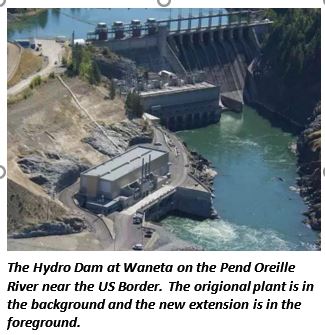
When first built, the plant was equipped with two generators – 90 MW each, but the powerhouse was equipped to accommodate 4 generators. In that plant, the 2 generators could run almost continuously at 180 MW with a few short periods, when flows were very low, that capacity might be reduced to 150-160 MW. But for almost half of each year, the spillway discharged much more water than was going through the generator turbines.

After a few years later, my employer signed an “equi-change” agreement with another utility that had opposite capability, or storage. Soon, two generators were added, and for half of the year, we ran 4 generators, and exported the equivalent of 1 generator, while for the other half of the year, we ran 2 generators, but imported the equivalent of 1 generator. We had a plant that provided about 270 MW of firm power.

You can imagine my surprise a few years ago, when I learned that they were building an extension to the plant, that would generate a further 335 MW of capacity. The total capacity, after upgrades to the existing powerhouse totalled more than 700 MW. I wondered how they would ever make that pay, as there were only a few weeks each year when there was enough water to generate that much power. Graph
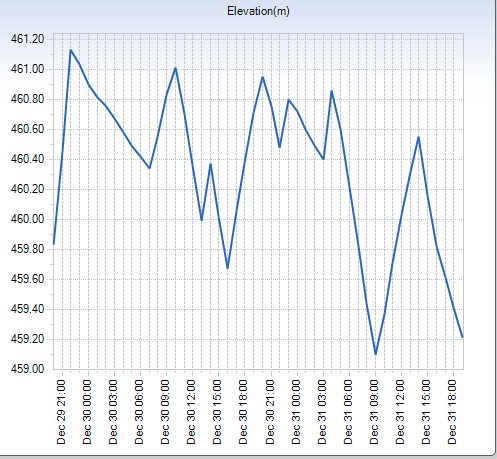
It didn’t take long to find out what they were doing. When I worked there, I became an operator, and we were always careful to keep the forebay at a constant level – as high as possible, to get the most power from every bit of water than went through the turbines. We were rarely down more than an inch or two from the full pond level.

I can now see the forebay level on the internet, and what has happened is remarkable. The graph shows the forebay level over a 2 day period, and one can see that they are using the storage behind the dam, small as it is, to generate energy for peak periods and store during off peak periods. The old generators and turbines have been  upgraded and the plant now has a firm capacity of as much as 200 MW, but the capacity is over 700 MW. For those in the US, the readings are in M, (1 M is a little over 3 ft) so the forebay level was run up and down by more than 6 ft in 1-2 days. So much for our 2 inch limits. The average capacity factor is far less than 50%. The wind advocates may want to claim that their wind turbine can beat this… but there is one key difference. This capacity is fully dispatched. It can be called when needed and stopped – to store energy when not needed. They generate when it makes economic sense, and reduce capacity dramatically when prices are low. What is interesting is the fact that this plant has a small reservoir (5-6 miles in length) and the storage in that forebay has justified the construction of a second almost equal capacity powerhouse that cost almost 30 times the total cost of the initial dam and powerhouse.

Most hydro plants are now built with far more capacity than they can run continuously, but these plants can all be dispatched when and as needed. In this way, they are very different than wind or solar. The key difference is that they can be dispatched at any time to whatever capacity is needed, provided there is water available behind the dam.

What is really needed is a way to have the intermittent generators work in an optimized way with plants such as hydro that can be dispatched, to get all of the energy that we can get from the renewables, and store it efficiently. This form of storage is near to 100% efficient. I would suggest, that most of these plants were built, based on the value of the energy produced and not on the storage provided. The storage is almost free. The picture is now rapidly changing and storage may soon have much more value than the energy generated.

And that brings up the real definition of storage in the grid. Electricity used to be used in the very instant that it was generated. Storage allows the separation of the generation time and the consumption time.

There is a great future for batteries, but they remain a dedicated, and relatively costly device. There are many other forms of storage that can be leveraged; devices that were bought and paid for to provide another service, much like the old generating station, that can be used to do the same thing, but at the grid edge, where there is almost no energy loss between a storage device and the load the process may be even more efficient. We see the rapid advance of Virtual Power Plants (VPPs) that manage a wide variety of devices that can effectively deliver a large impact from many small storage devices, such as domestic water heaters, EV chargers, air conditioning units, water pumps etc.

We are entering a time when the entire grid operation will need to be optimized to gain maximum benefits from every source available, including the most intermittent sources, and the VPP will play a huge role in this. Some utilities are currently participating in imbalance markets that match shortages with surpluses. But this will need to grow to include behind the meter devices. The missing link may be the need to have all players around a single table, all agreeing to solve the problem in the best way, and a means to fairly share the benefits.
A Little Fun – for a Change

I teach an engineering course at a local university –students in their last year learn about power system design, and I have loved the opportunity to work with these keen young minds.

After the final exam a few weeks ago, one of the students asked about what had changed since I was a student? I laughed and decided to tell a few bad tales…

On my first day – in first year engineering, back in 1963, I was in my first class – Geology 150. A loud bang on the door occurred and in marched 5 or 6 very tough looking 4th year engineering students… “Who has not bought an engineering sweater?” was the question… Thinking that it would be a good time to buy, I put up a hand. I was instantly grabbed by the biggest 4 of these “thugs,” hauled out and thrown head first into the lily pond outside. Soaked, I was dragged back in – and deposited on the bare cold floor in front of the class… “Anyone else not got a sweater yet??” The class was deadly silent. I left, changed, bought a sweater and came back to class. Lesson 1 learned – and not about geology.

A few weeks later, I attended one of our weekly noon meetings – all dressed in our red sweaters. During the summer, a few students had made some very ugly statues, complete with little bronze castings with “In memory of….” on each statue, and all of these monstrosities had been placed around the arts building. We marched out chanting – “do we like these…. NO!!!”… “what are we going to do…??” And we promptly smashed every one to bits. The two local papers were furious at the engineers… and even the TV networks referred to us as savages.. A few days later the truth came out. That was fun.

Later there were other stunts. A group stole the “Speakers Chair” from the provincial legislature, and the 9 PM Gun, an artifact in Vancouver that goes off every night at exactly 9 PM, disappeared. Both were returned unharmed after about a week.

But the stunt that provokes a lot of strange memories was done by a small group of engineers. They made a very large batch of good cookies – laced with an organic indicator, that they had been assured would not be harmful. The indicator turned red in an acid liquid.

One of the group put a desk in the lobby of the lecture theatre where arts students were to have a big meeting. They gave out cookies – a gift from the engineers. A few hours later, there was a long line of students at the university health centre, certain that they were all suffering from internal bleeding. It was quite outrageous. The chemistry professor that taught the students responsible for the stunt failed them all, for 2 or 3 years after. One that I knew and still see from time to time, had to give up on his engineering future, and became an architect. He is now retired.

My students laughed at me and told me that they would surely be jailed if they tried ANY of the stunts that we had thought were funny. And on reflection, they were probably correct. How intolerant have we become, and how much fun some of the stunts were. Most were aimed at situations, and care was taken not to target any individual or group..

There is a lesson here. Some of the worst “hell raisers” in my years as a student did well in their careers.  One became the head of a large oil company, and others did some remarkable work. These people had minds that could come up with “out of the box” ides, outrageous as they may have been. But I do think that more of this kind of thought is what is needed today. We need innovation, out of the box thought, and the ability to turn some crazy vision into a practical reality. Those were fun years.

A Few Thoughts from an OLD Canadian Engineer on Climate Change and Energy

  1. I am not a climate denier – and in fact, it terrifies me. Even though I am well past retirement, I do continue to work on potential solutions and I am currently both a teacher and a student on this topic at a local university.
  2. We have 12 years to turn this around.
  3. There is a huge amount of bad information around – many people are “instant experts” believing that renewables can just do it all – in a few years!!!
  4. People like to blame the US, China and India for all the problems but in fact, Iceland uses more energy per capita than anywhere. Canada is worse than the US, and both China and India use a fraction of the annual energy per person that Canada and the US use. We need to look in the mirror before blaming others.
  5. Energy is delivered to customers either as electricity or as a form of fossil fuel (for the most part).
  6. Coal creates about DOUBLE the GHG emissions than created by Natural Gas – for the same heat content. Steam turbine generation (burning coal) for electricity is about 30% efficient.  Natural gas in a Combined Heat and Power plant can operate at better than 80% – with emissions that are a fraction of coal generation as it exists.
  7. Electricity delivers less than 20% of the total energy to customers in North America – to put all energy delivery on the electric grid is a huge challenge.
  8. Solar advocates love to claim that solar power has a large fraction of the supply CAPACITY, but these sources run for relatively short periods
  9. People seem to think that new battery technology will change everything…
    1. Batteries are great for day-night operation or for short outages. But summer to winter storage is another matter.
    2. I did a study on my own home. Most of the incoming solar comes between May and October.  Most consumption is between November and March (including heating).
    3. My home needs a 5 MWh battery – and at HALF of the projected price for 2025, that would cost me $250,000 US.  Not affordable for most people and not enough time.
  10. The major sources of GHG emissions in the US is Electricity generation and second is Transportation. The fleet of US personal vehicles uses more energy than the entire electric grid generates.  So much for the BC estimate of 8% increase in demand from 100% EVs.  (Don’t get me wrong – if the electricity supply is clean, EVs are the way of the future.  I own ONE car – an EV!
  11. Canadian Emissions come largely from Transportation and the Oil industry – this needs to be looked at.
  12. The potential for shared driverless cars is potentially one of the best changes that we can easily implement that would REDUCE user costs, REDUCE emissions, and provide reliable transport for everyone.
  13. We have a difficult problem ahead, but what is really needed is for all players (Utilities, solar producers, homeowners, industry etc.) to partner in finding a coordinated solution that is good for everyone. There is a role for everyone – and all can benefit, both financially and in protecting our planet.

Installing Solar – Consider adding battery storage

I saw a quote by James Avery, the Senior Vice-President of Power Supply at San Diego Gas and Electric (SDGE) suggesting that “until you couple solar with energy storage devices, it’s not going to be a benefit to the grid. This strong statement from a senior executive at a large utility may have more importance in cool climates than it has in Southern California.

I was recently talking with a heating service technician He believed that as soon as battery prices declined as expected, that there would be no need for utilities, and we would all be self-sufficient. We see a lot of governments pushing the concept of Zero Net Energy concept without explaining that they meant “Zero Net Energy Ready…”

By chance, I have been driving an Electric Vehicle (EV) for a little over one year, so my house gas and electric utility bills reflect the costs of typical electricity use as well as auto fuel and heating (I have both a heat pump and a high efficiency natural gas furnace. I also have a good quality Heat Recovery Ventilator.

I plotted the monthly energy use, and the incident monthly solar energy in my area, aiming to make the annual supply equal to the annual demand. The result was a surprise – as we get most of our solar energy between late spring and early fall but use most of our energy during winter months. The battery size for my modest home, to store summer energy for winter use was almost 5 MWh – a huge battery. If I assumed that the cost would fall from over $200/kWh to about $50/kWh, the cost at the low end would be almost $250,000 US to provide me with year-round energy, with no reserve capacity.

The quote by James Avery reveals another side of the issue. Utilities have generally charged residential customers for energy used in kWh. This is unlike the commercial and industrial customers that pay an additional “demand” charge for the peak power drawn. Utilities appear to be incurring real problems with their regulated residential rate structure, as solar is implemented. Much of the solar energy arrives in the afternoons, when the demand is relatively low, and there is little if any energy available from these sources after sunset, when most utilities see their daily peak demand. Total energy sales are declining as a result of the domestic solar supply, but the peak demand after sunset is continuing to grow. The grid design is based on peak demand, so there is a need for new capacity to meet a growing peak, but with revenue falling, there is a lack of funds to pay for the additions. Ultimately the residential rates are rising to meet the costs, and according to Mr Avery, the people without solar are paying to subsidize the ones that have installed solar systems.

The utilities are seeing other problems as well. The “duck curve” reveals that demand falls rapidly in the morning with the rising of the sun and rises equally rapidly at sunset. The afternoon increase is followed, almost immediately, with a rapid rise to the evening peak. Most conventional generators cannot meet the required change in demand over such short periods.  Some utilities are also seeing so much energy injected from solar sources into the grid in the afternoons, that they are forced to PAY other utilities to take it, only to have to buy it back, after sunset. In short, these utilities are paying three times for the same energy. They buy it from the home owner, pay a utility to take surplus, and pay again to get it back. There needs to be a better way.

Some utilities are seeking approval for a peak demand charge for residential users, and in one case that I spoke with, the company was looking at giving the energy to users at no charge but adding a large demand charge. The net utility revenue would then follow demand, but the addition of a solar system on a residence would likely deliver no savings at all. I know of another utility that has applied to withdraw a tariff that was used to purchase surplus solar from residential users.

If a demand charge is implemented for residential users, a solar user that does not have storage could find that the total cost of energy with the solar operating during the day would deliver little or no savings at all.

There are clearly two sides to this story; the utility is being put into a position that is financially unviable, while a home owner that wants to do what he believes is right is essentially caught in what could easily become a zero-sum game; one side wins, the other loses.

There needs to be a better way, and there probably is.

If one looks at most homes, the electric service is designed to deliver 30-50 kW of power, and yet, the average demand by residential users is about 1 kW. The change to electrify many fossil fuel loads is going to require much more energy to be delivered. The energy may come from central generation, or it may come from a wind turbine down the street. What is going to be important is efficiency as well as a means to utilize the full capacity of the grid to deliver energy. The existing transmission grid operates at an average of about 50% of its design capacity, providing the larger range to meet peak demand periods.

A home owner may want to install a battery with a new solar system, one that would allow them to collect energy during the daytime and use it to reduce their peak demand after sunset. Any utility demand charge would then be dramatically reduced. This could be a first step, but if the utility were allowed to control the charging of the battery, an option that they might pay for, then the benefits could be optimized for both the utility and the customer. Many utilities have demonstrated that they are very capable of high quality routine optimization of their operations.  Some utilities are already controlling domestic hot water heaters, heating water when there is low demand, but ensuring that the customer has hot water when needed. The same concept could easily be applied to EV chargers, storage on solar systems and multiple other domestic applications that have inherent storage.

There needs to be a paradigm shift, where home owners and utilities see each other as partners. Both sides can win by working together to optimize the total operation. That way, everyone can save, and emissions can decline significantly.